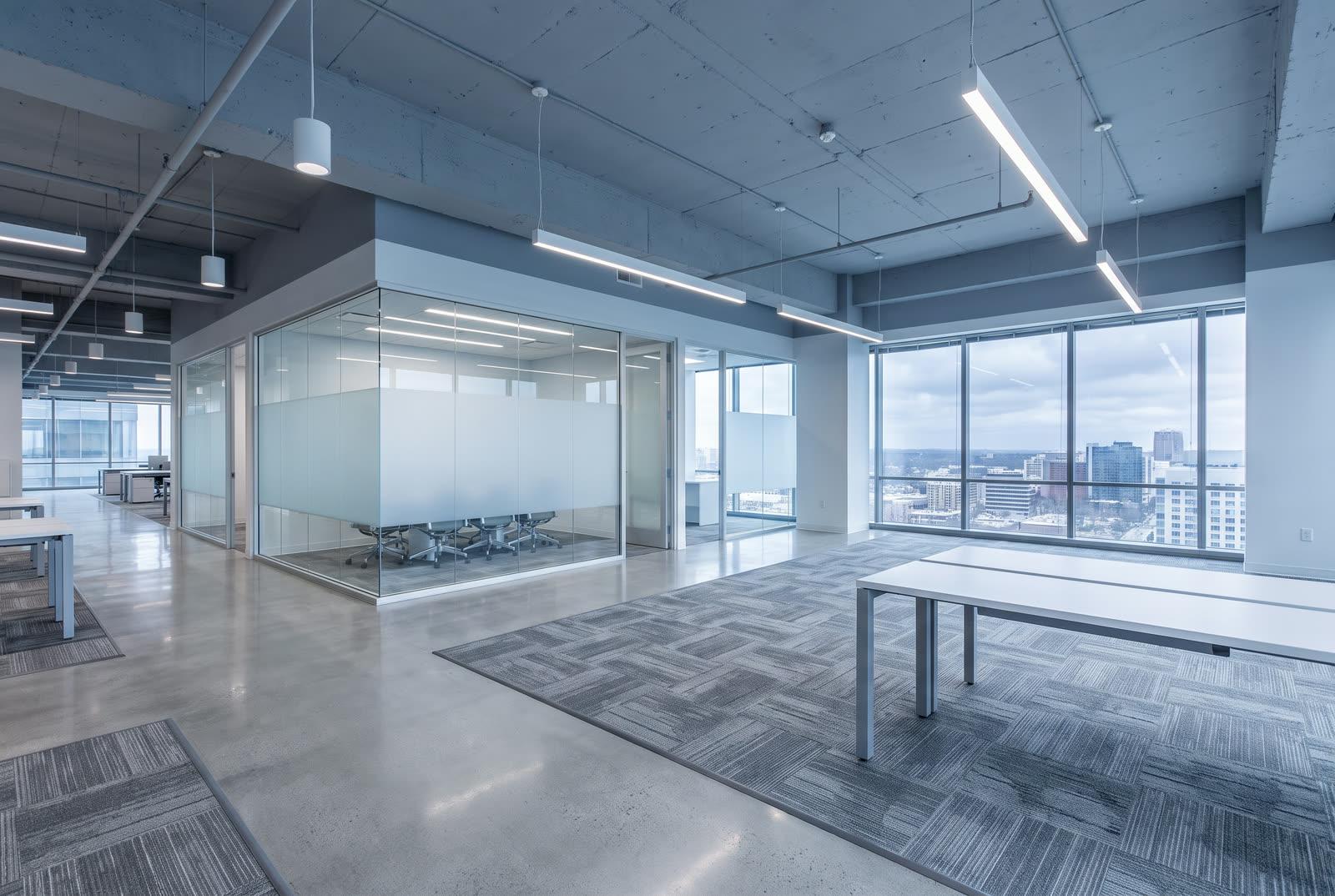
Meadowvale Office Retrofit
Commercial · Mississauga, ON

Service
Owner-side construction management for commercial and industrial builds, BC and Ontario.
Construction management is a delivery model where the owner hires a construction manager to plan, price, tender and supervise a project. Synergistix Group Ltd. serves as construction manager on commercial and industrial builds in British Columbia and Ontario, running preconstruction, trade buyout, scheduling, site supervision, cost control and closeout under one accountable contract.
What's included
We review drawings and specifications before they are issued for tender, flagging coordination conflicts, missing scope, long-lead equipment and site constraints while changes still cost drafting time rather than demolition.
Budgets are built from measured quantities and current trade pricing, then tracked line by line against commitments and forecasts. Owners see the same cost report we work from, every month.
Scope is divided into clean trade packages, tendered to prequalified subcontractors, levelled on an apples-to-apples basis, then awarded with the gaps and exclusions closed before the first crew mobilizes.
A resource-loaded critical-path schedule sets milestones, trade sequencing, inspection holds and long-lead procurement dates. Progress is measured against baseline weekly, and slippage is reported with a recovery plan attached.
Full-time supervision covers daily coordination, trade productivity, inspection scheduling and deficiency tracking. Safety administration runs to COR standards, with orientations, toolbox talks and documented hazard assessments on every active site.
Requests for information, site instructions and change orders move through one logged process with priced impact on cost and schedule. Closeout delivers as-builts, warranties, manuals and training in an indexed package.
How the engagement runs
We confirm the objectives, budget envelope, schedule constraints and risk tolerance, then set the delivery model. CM-at-risk suits owners who want a guaranteed maximum price. CM-as-agent suits owners who hold trade contracts directly.
Drawings go through constructability and coordination review while the estimate is built from measured quantities. Value engineering options, long-lead procurement and permitting timelines are settled before the documents are issued for tender.
Trade packages are tendered to prequalified subcontractors and levelled for scope gaps. Awards are recommended with pricing open to the owner, and the guaranteed maximum price is set once buyout is substantially complete.
Site supervision runs daily coordination, safety administration, inspections and quality holds. Cost, schedule, RFIs, changes and deficiencies are reported to the owner on a fixed monthly cycle with forecasts to completion.
Deficiency lists are closed, commissioning and authority inspections completed, and occupancy secured. The owner receives as-built drawings, operating manuals, warranty documentation and maintenance training, followed by a warranty review before the first year ends.
Construction management puts a professional builder on the owner’s side of the table from the first cost plan onward. Instead of receiving a single lump-sum bid at the end of design, the owner gets pricing, constructability input and schedule logic while decisions are still cheap to change. Synergistix Group Ltd. runs commercial and industrial projects on this model from Surrey, serving Metro Vancouver and the Fraser Valley, and from Mississauga, serving the Greater Toronto Area and Peel Region.
The difference between the two models is who carries the trade contracts and who carries the risk attached to them. Under CM-at-risk, Synergistix holds the subcontracts and commits to a guaranteed maximum price, so cost above that ceiling is the construction manager’s exposure rather than the owner’s. Under CM-as-agent, the owner holds each trade contract directly and Synergistix acts as a fee-based advisor and administrator, running the same preconstruction, tendering and site processes without taking contractual risk on the trades. Owners with in-house project capability and a tolerance for direct exposure often prefer the agency model. Owners who need a single accountable party and a hard ceiling on cost choose CM-at-risk.
| Factor | CM-at-risk | CM-as-agent |
|---|---|---|
| Who holds the trade contracts | Construction manager | Owner |
| Cost commitment to the owner | Guaranteed maximum price | Cost plan and estimate only |
| Who absorbs overrun above the ceiling | Construction manager | Owner |
| Owner administrative load | Low, one contract to manage | High, one contract per trade |
| Typical fit | Owners who want cost certainty and one accountable party | Owners with in-house project staff who want direct control |
A guaranteed maximum price is a ceiling, not a fixed price. It is assembled from awarded trade contracts, general conditions, a construction contingency and the construction manager’s fee, and it is set once buyout is far enough along that the numbers are real rather than notional. Work is still billed at actual cost, so if the trades come in under the ceiling the owner keeps the difference or shares it under an agreed savings clause. Contingency is the part owners most often misread. Construction contingency covers unknowns inside the awarded scope, such as concealed conditions and coordination gaps between trades. It does not fund owner-initiated scope changes, which belong in a separate owner’s allowance. Keeping those two pools distinct is what keeps the cost report honest as the job progresses.
By the time a crew is on site, most of the cost is already committed. Preconstruction is the window in which a construction manager earns the fee, and it is also the phase owners are most tempted to compress. A constructability review reads the drawings the way a foreman will read them, looking for details that cannot be built as drawn, trades whose scope overlaps or falls between packages, equipment with lead times longer than the schedule allows, and site conditions the design has not accounted for. Every one of those items is cheap to resolve on paper and expensive to resolve in the field.
The schedule is a critical-path model, not a bar chart produced for the kickoff meeting and never opened again. Activities are sequenced with realistic durations, logic ties and float, so when one trade slips the effect on the completion date is visible that week rather than at the end of the quarter. Milestones that matter to the owner, such as envelope closure, power energization, equipment set and occupancy inspection, are tracked as separate constraints with their own predecessors. Progress is measured against the baseline, and any variance is reported together with the resequencing that will absorb it.
Changes and requests for information run through one logged process with dates, responsible parties and priced impacts. An RFI left unanswered turns into a delay claim, so response time is tracked as a performance measure on both sides of the contract. Change orders are priced with labour, material, equipment and schedule impact broken out separately, and they are approved before the work proceeds rather than reconciled afterward. Quality control runs on inspection and test plans tied to the specification, with hold points that stop the following trade from covering work that has not been verified.
Synergistix is registered with WorkSafeBC for its British Columbia operations, carries WSIB coverage for its Ontario operations, and holds COR safety certification. Working under both regimes means site documentation has to satisfy two regulators whose requirements are not interchangeable. Notice of project filings, prime contractor designation in British Columbia and constructor designation in Ontario, hazard assessment formats and incident reporting thresholds all differ, and applying the wrong province’s process is a compliance failure even where the underlying field practice is sound. Certificates of insurance are issued COI-ready in the form property managers and developers actually require, with the correct additional insureds and limits named. The firm is licensed and insured in both provinces.
Closeout is a scheduled phase with its own resources, not a scramble after substantial completion. Deficiency review begins before the trades demobilize, because an item found while the electrician is still on site costs a fraction of what it costs to bring that electrician back. Commissioning, authority inspections and occupancy approvals are sequenced so that no single missing sign-off holds the handover date hostage. The owner receives as-built drawings that reflect what was actually installed, operating and maintenance manuals, equipment warranties with start dates recorded, spare parts and attic stock, and training for the staff who will run the building. A warranty review before the first year closes catches the items that only surface after a full heating and cooling season.
Related work
Commercial · Mississauga, ON
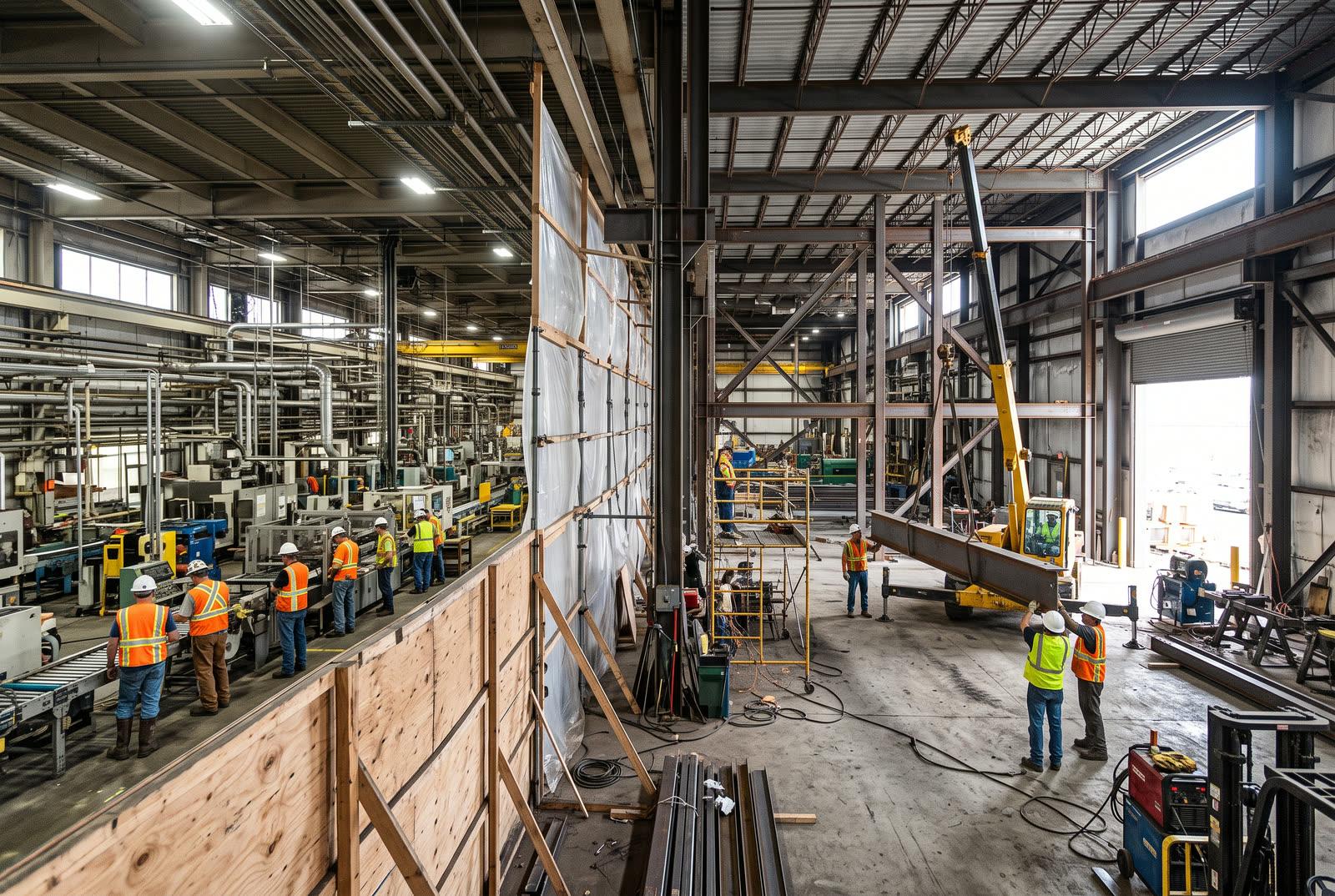
Industrial · Surrey, BC
Send drawings, a scope outline, or the problem you are trying to solve. We will tell you which delivery model fits and what it should cost.