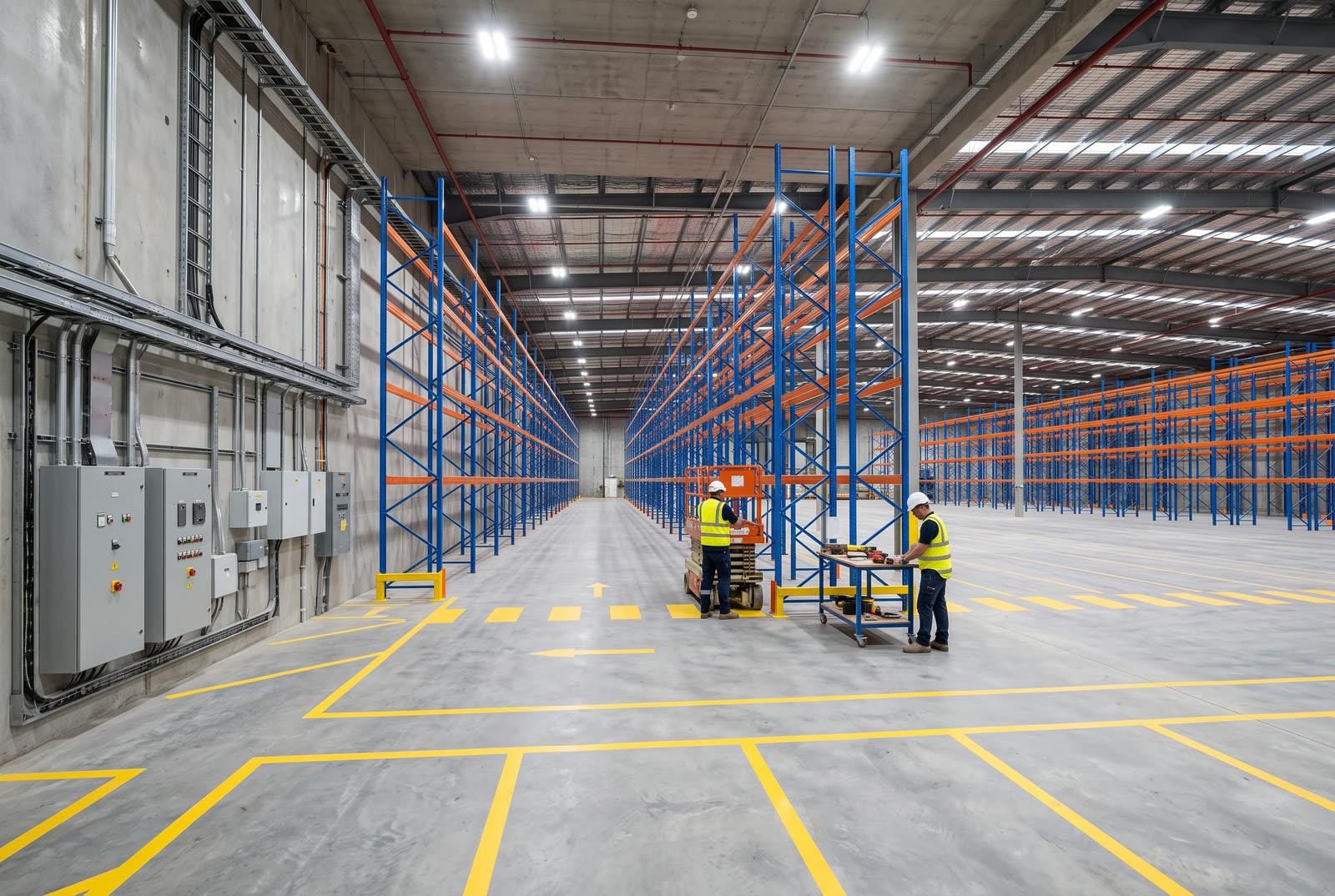
Heartland Logistics Hub Fit-Out
Industrial · Brampton, ON

Service
Owner-side control of scope, budget, schedule, consultants, and approvals.
Construction project management places Synergistix on the owner’s side of the table. We control scope, budget, schedule, consultants, and approvals from feasibility through turnover, procuring and evaluating contractors on the owner’s behalf. Owners in British Columbia and Ontario get one accountable representative protecting their interests at every decision point.
What's included
We test the project before it starts. Site constraints, zoning, servicing capacity, order-of-magnitude cost, and schedule are assessed so the owner can commit, revise, or cancel early with facts.
We scope, tender, and manage the consultant team: architect, structural, mechanical, electrical, and civil. Deliverables, fee structures, and review milestones are defined in writing before design work begins.
We run the approvals path through the authority having jurisdiction, tracking rezoning, development permits, building permits, and trade permits. Municipal comment cycles are anticipated in the schedule rather than absorbed as delay.
We build the control budget, hold the contingency, and forecast monthly cash flow against draw schedules. Every change is priced, logged, and approved before it reaches the owner’s committed cost.
We maintain a live risk register with an assigned owner, probability, impact, and mitigation for each item, and review the master schedule against it so exposure is retired before it becomes cost.
We prepare tender documents, qualify bidders, run the bid process, and evaluate submissions on price, schedule, safety record, and bonding capacity. The owner sees a written recommendation, not a single number.
How the engagement runs
We convert the owner’s objective into a defined project: site assessment, zoning and servicing review, order-of-magnitude budget, and a target schedule. The output is a business case the owner can approve or reject.
We procure the architect and engineering consultants, set deliverables and fee structures, and chair design meetings. Each design stage is reviewed against budget and schedule before the owner authorizes the next one.
We carry the permit applications through the municipality and, in parallel, prequalify contractors and issue tender documents. Bids are levelled, interviewed, and reported to the owner with a written award recommendation.
We monitor the contractor against the contract: site progress, quality, safety compliance, change orders, payment certification, and the risk register. The owner receives one reporting package covering cost, schedule, and open issues.
We manage commissioning, deficiency close-out, occupancy approvals, and the handover package: as-built drawings, warranties, operating manuals, and training. Holdback release is recommended only once the documented obligations are met.
Owners engage a project manager when the cost of getting a project wrong exceeds the cost of managing it properly. Synergistix works from the owner’s side of the table, holding the authority to direct consultants, test contractor pricing, and defend the schedule against the pressures that erode it.
A project manager engaged by the owner has no financial interest in the construction contract. That independence is the point. When the general contractor submits a change order, the party evaluating it is not the party who benefits from it. When a consultant proposes a detail that adds cost without adding value to the asset, someone with budget authority is in the room to say so before the drawing is issued.
The role is control, not observation. Synergistix holds the master budget, the master schedule, and the risk register, and reports against all three in a single package each period. Consultants report to us. The contractor is administered by us. The owner receives decisions framed with options, cost, and schedule impact rather than a stack of forwarded correspondence.
The two are frequently conflated, and the distinction matters at the moment something goes wrong. Project management is advocacy and control on behalf of the owner. Construction management is delivery: trade procurement, site supervision, coordination, and physical execution of the work. Synergistix provides both, and on any given project the owner should be clear which one they have bought and who is accountable for what.
| Question | Project Management | Construction Management |
|---|---|---|
| Whose side of the table | The owner’s | The delivery team’s |
| Primary duty | Protect scope, budget, and schedule | Build the work safely, on schedule, to spec |
| Holds the trade contracts | No, the owner or the contractor does | Yes, in most structures |
| Typical engagement start | Before design begins | At design development or tender |
| Change orders | Evaluates and recommends on the owner’s behalf | Prices, prepares, and submits them |
| Measured by | Cost certainty and approval outcomes | Site productivity and delivered quality |
Owners who engage a project manager and a construction manager separately gain an independent check on pricing and progress. Owners who combine both under one firm gain speed and a single point of accountability. Neither structure is universally correct. The decision turns on the owner’s internal capacity, the complexity of the approvals path, and how much cost risk the owner is prepared to carry.
A project manager working in both provinces runs two regulatory playbooks. In British Columbia the BC Building Code governs the work and site safety falls under WorkSafeBC. In Ontario the Ontario Building Code applies and workplace coverage runs through WSIB. Technical requirements diverge, inspection practice diverges, and municipal review timelines vary considerably between a Fraser Valley municipality and one in Peel Region.
Payment administration also differs. Ontario’s prompt payment and adjudication regime sets defined timelines for certifying and paying invoices, and an owner represented by someone who misses them carries avoidable exposure. British Columbia manages the same risk through statutory holdback and lien periods. We administer certification, holdback, and release under the rules of the province the project sits in, not a generic national template.
Most overruns on commercial and industrial projects trace back to decisions made without a written record of their cost. A verbal instruction on site. A design clarification issued straight to the contractor. A scope assumption never tested against the drawings. By the time the invoice arrives, the argument is unwinnable because the owner has no contemporaneous record of what was agreed, when, or at what price.
Industry practice on a well-run commercial project is to carry a design contingency through early stages and draw it down as documents mature, with a separate construction contingency held by the owner rather than by the contractor. Synergistix runs that structure, tracks drawdown each period, and reports the forecast to completion every month. When contingency is spent, the owner knows exactly what it bought.
Each reporting period the owner receives committed cost to date, forecast to completion, contingency position, schedule status against baseline, open risks with mitigation status, and the decisions required before the next period closes. The purpose is not to describe the project. It is to put the owner in a position to make the two or three decisions that actually move it.
Related work
Industrial · Brampton, ON
Send drawings, a scope outline, or the problem you are trying to solve. We will tell you which delivery model fits and what it should cost.